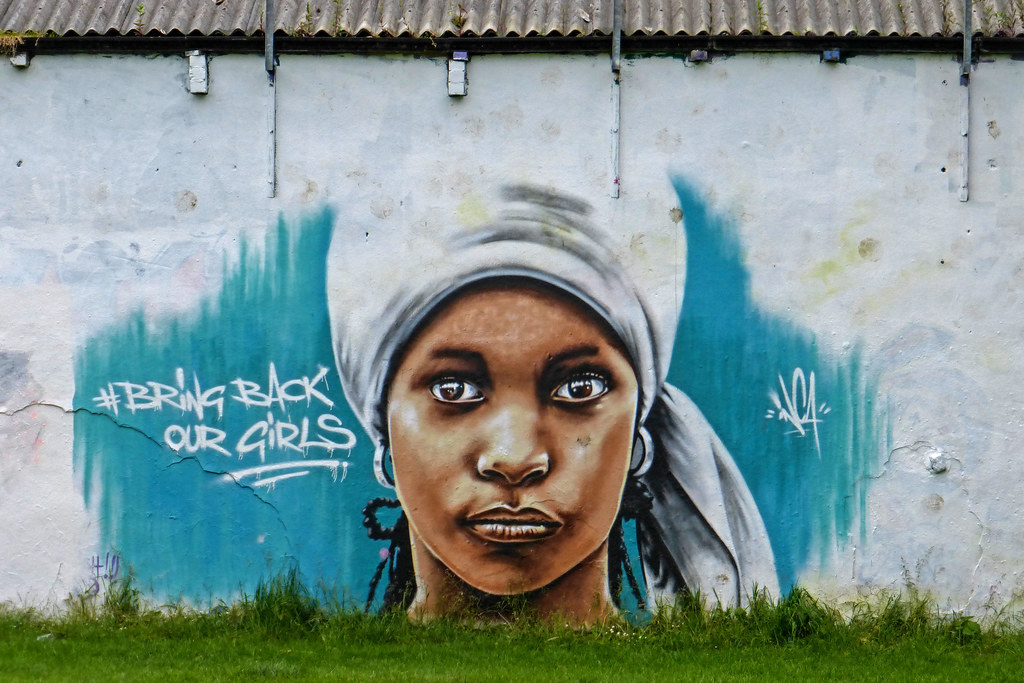
How Boko Haram is Taking West Africa Backwards
Schools are supposed to be a place where students feel protected and safe. In light of the recent school shootings in the United States, however, American children are beginning to feel increasingly insecure and in danger when they enter their school campuses. But it’s not just students in the United States who are feeling this way. Young girls and boys in West Africa are also scared for their lives not only at school, but even when they are in their homes, hiding from Boko Haram fighters, an extremist group wreaking havoc in Nigeria and surrounding countries (Wilson).
After the rebel group declared an insurgency against the Nigerian government in 2009, they have kidnapped hundreds of girls and boys, killed more than 20,000 people, and displaced over 2.5 million citizens from their homes (Wilson)(Searcey). Led by Abubakar Shekau, Boko Haram operates in Maiduguri, a Nigerian city, and their name translates to “Western Education is Forbidden” (Searcey). Their goal is to create an Islamic caliphate in West Africa (Wilson).
Their ability to abduct hundreds of children at a time and ransack villages has made them a unique terrorist group that is very difficult to understand (Wilson). Researchers have not understood how Boko Haram continues to conduct its terrorist activities. Some of the socio-political issues in West Africa are linked to Boko Haram on two main accounts - the challenges that women and girls face after being kidnapped, and government corruption that fuels Boko Haram.
Generally, when women and girls are abducted, they are put into slavery or forced to marry a Boko Haram fighter. A lot of times they are also impregnated by the fighters at a young age (Quist-Arcton). Some of the captured girls manage to escape and return to their homes, but that unleashes another set of challenges for them. Instead of being supported, these girls are ostracized by their families and society and often abandoned. (Quist-Arcton). For the girls who are unable to escape from captivity, they are stripped of their religious freedom and threatened to be killed if they don’t convert to Islam (Quist-Arcton).
Moreover, studies show that corruption is the driving force behind the rise in extremism (Hashimu). Because of corruption, the tax dollars meant to fight Boko Haram are being funneled to Boko Haram. Furthermore, Boko Haram is delegitimizing the Nigerian government by stating that the government is corrupt and only an Islamic state can provide a fair and just society (Hashimu). This is how Boko Haram is affecting the political reality. More than 15 billion dollars that was allocated to address and fight Boko Haram has gone missing and into the possession of military officers (Hashimu). Upon receiving this money, corrupt officials invest in properties overseas in Europe; research shows that at least 75 million euros worth of property in London is owned by Nigerians (Hashimu). Additionally, government officials were deemed guilty for money laundering in UK courts (Hashimu). Despite his claims to end corruption, Muhammadu Buhari, the President of Nigeria, has failed to curb corruption (Hashimu).
Overall, there has been little to no improvement in the situation as government corruption has sabotaged any action against Boko Haram. The victimized women and girls have little access to any psychological counseling that can help them overcome the trauma and stigma (Segun). Until these socio-political issues are addressed, Boko Haram will thrive at the expense of the Nigeran people.
Works Cited
Hashimu, Salaudeen. “Boko Haram Feeds off Corruption in Nigeria.” Nigeria | Al Jazeera, Al
Jazeera, 14 Apr. 2017,
www.aljazeera.com/indepth/opinion/2017/04/boko-haram-feeds-corruption-nigeria-1704
--. “Boko Haram Video Is Said to Show Captured Girls From Chibok.” The New York Times, The
New York Times, 15 Jan. 2018,
www.nytimes.com/2018/01/15/world/africa/boko-haram-chibok-girls-video.html.
www.nytimes.com/2018/01/15/world/africa/boko-haram-chibok-girls-video.html.
Segun, Mausi. “Dispatches: Protect Lives, Not Just Territory, Against Attacks.” Human Rights
Watch, N.p., 12 Apr. 2016,
www.hrw.org/news/2016/02/04/dispatches-protect-lives-not-just-territory-against-attacks.
Quist-Arcton, Ofeibea. “The Lament Of The Boko Haram 'Brides'.” NPR, NPR, 27 Aug.
2017,www.npr.org/sections/goatsandsoda/2017/08/27/545912049/the-lament-of-the-boko-haram-brides.
Wilson, Mark. “Nigeria's Boko Haram Attacks in Numbers - as Lethal as Ever.” BBC News,
BBC, 25 Jan. 2018, www.bbc.com/news/world-africa-42735414.

I appreciate the way you included lots of evidence to support each main point and show the seriousness of your topic. You also used a variety of sources to provide this information which was great.
ReplyDelete