Nigeria: Deserting Desertification
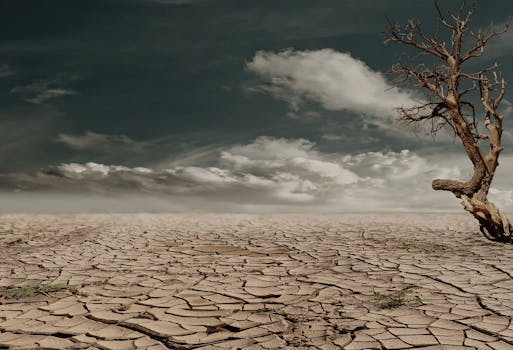
When most people think of Africa’s environment, images of dry, barren deserts usually come to mind. While much of Africa is desert, the continent is also filled with green mountains, colorful rainforests, and swampy wetlands. But the dry, barren deserts most people associate with Africa are quickly taking over the land because of desertification, a process in which arable and farmable land becomes dry and unusable. In Nigeria, Africa’s biggest country, desertification is a major problem that is tearing the country apart.
The loss of arable land has been a problem in Nigeria since the 1920s. The Sahel famines in the late 20th century and lack of rainfall both have augmented the consequences of desertification. One of the main root causes of desertification is deforestation. Since over 10% of Nigeria’s economy comes from logging and wood processing, Nigeria’s forests are decreasing in size (Ulah). However, this deforestation comes at a greater cost to Nigeria’s economy than the profits the deforestation brings (Ulah). Without topiary cover, Nigeria’s winds blow away nutrient-rich soil and leaves behind arid sand, creating a more desert-like environment.
While desertification may not seem like a pressing issue, it has huge implications on the Nigerian people. It not only leaves behind less arable land, but also creates fewer jobs and more poverty in Nigeria. Since desertification produces non-farmable land, farmers are left with less and less land to farm on. Nearly 83% of rural Sub–Saharan Africans depend on land for their income, and 40% of land resources are currently degraded (NAGGW). In northern Nigeria, desertification endangers the jobs of over 40 million people (NAGGW).
Desertification doesn’t just endanger the Nigerian people’s jobs; it also endangers their lives. In Nigeria, religious groups are divided in two regions with Muslim herdsmen in the North and Christian farmers in the South. But with less and less farming land available in the North, Muslim herdsmen must move South to thrive. Religious values and disagreement about land ownership between Muslims and Christians cause disputes between the two groups, resulting in conflict and violence. The tensions have escalated to the point where death is a consequence of these altercations. In fact, over 80 people have been killed as a result since the start of 2018 (Olagunju).
The Nigerian government has realized the devastating possible ramifications of allowing desertification to spread and is actively working towards replenishing Nigeria’s land. In 2013, Nigeria’s government implemented the Great Green Wall Initiative, a project to reforest Northern Africa. The plan, which received $1.2 billion from the World Bank, includes building a “Great Green Wall” of trees an astonishing 4,350 miles long in the Sahel and Sahara regions. (NAGGW). Sadly, but not suprisingly, the Great Green Wall proved itself to be an impractical goal. Many trees were planted in places with no humans to take care of saplings, and over 80% of planted trees died (Morrison).
Nevertheless, there is still hope for Nigeria. Burkina Faso and Niger, two countries that were threatened by desertification, have managed to regreen their land (Morrison). Through indigenous land use techniques, farmers in the two countries have managed to much of their land from brown to green (Morrison). If the government implements effective policies to teach farmers how to reforest their land like Nigeria’s neighbors, Nigeria may be able to desert its deserts.
Works Cited
“Combating Desertification in Nigeria.” NAGGW, NAGGW, 3 Sept. 2017,ggwnigeria.gov.ng/
2016/10/15/combating-desertification-in-nigeria/.
“Desertification Fuels Deadly Clashes in Nigeria.” Deutsche Welle, Deutsche Welle, 8 Nov. 2016,
www.dw.com/en/desertification-fuels-deadly-clashes-in-nigeria/a-19468525.
Morrison, Jim. “The ‘Great Green Wall’ Didn't Stop Desertification, but It Evolved Into Something
That Might.” Smithsonian.com, Smithsonian Institution, 23 Aug. 2016,
www.smithsonianmag.com/science-nature/great -green-wall-stop-desertification-not-so-much-
180960171/.
Olagunju, Temidayo Ebenezer. “Drought, Desertification and the Nigerian Environment: A Review.”
Journal of Ecology and The Natural Environment, vol. 7, no. 7, 2015, pp. 196–209.,
doi:10.5897/jene2015.0523.
Ulah, Linus. “Briefing: Nigerian Farmers Can't Fight Desertification Alone.” IRIN, IRIN, 17 Nov.
2017, www.irinnews.org/analysis/2017/11/14/briefing-nigerian-farmers-can-t-fight-desertification-
alone.

I loved how you presented your topic with your hook. I didn't realize desertification endanger people's jobs and lives as well! My topic was Day Zero- when Cape Town is to run out of water, and I wonder how closely (if at all) related this drought is to desertification?
ReplyDeleteI really like how you explained the problem of desertification clearly and used imagery to interest the reader. My main take-away is that a lot of people are affected by desertification, and something needs to be done to help save lives. I wonder what the government of Nigeria plans to do now as the "Great Green Wall" plan failed.
ReplyDeleteIsabella! I like the vivid description in the hook, which really draws in your reader. The image that accompanies your article is really effective. I now realize that desertification can effect people's daily lives, such as their jobs, their food supply, and the economy. I wonder if there is anything that can be done to reverse the damage of desertification?
ReplyDeleteI like how you introduce your topic by contrasting deserts to lush land. My main take away was how people are affected by desertification. My follow up question is how is the government working to stop the spread of deserts?
ReplyDelete